
Events, Media, News, Resources
Global partnerships drive inaugural UN Regional Forum on Business and Human Rights at RMIT
Emilia Maubach | September 4, 2025
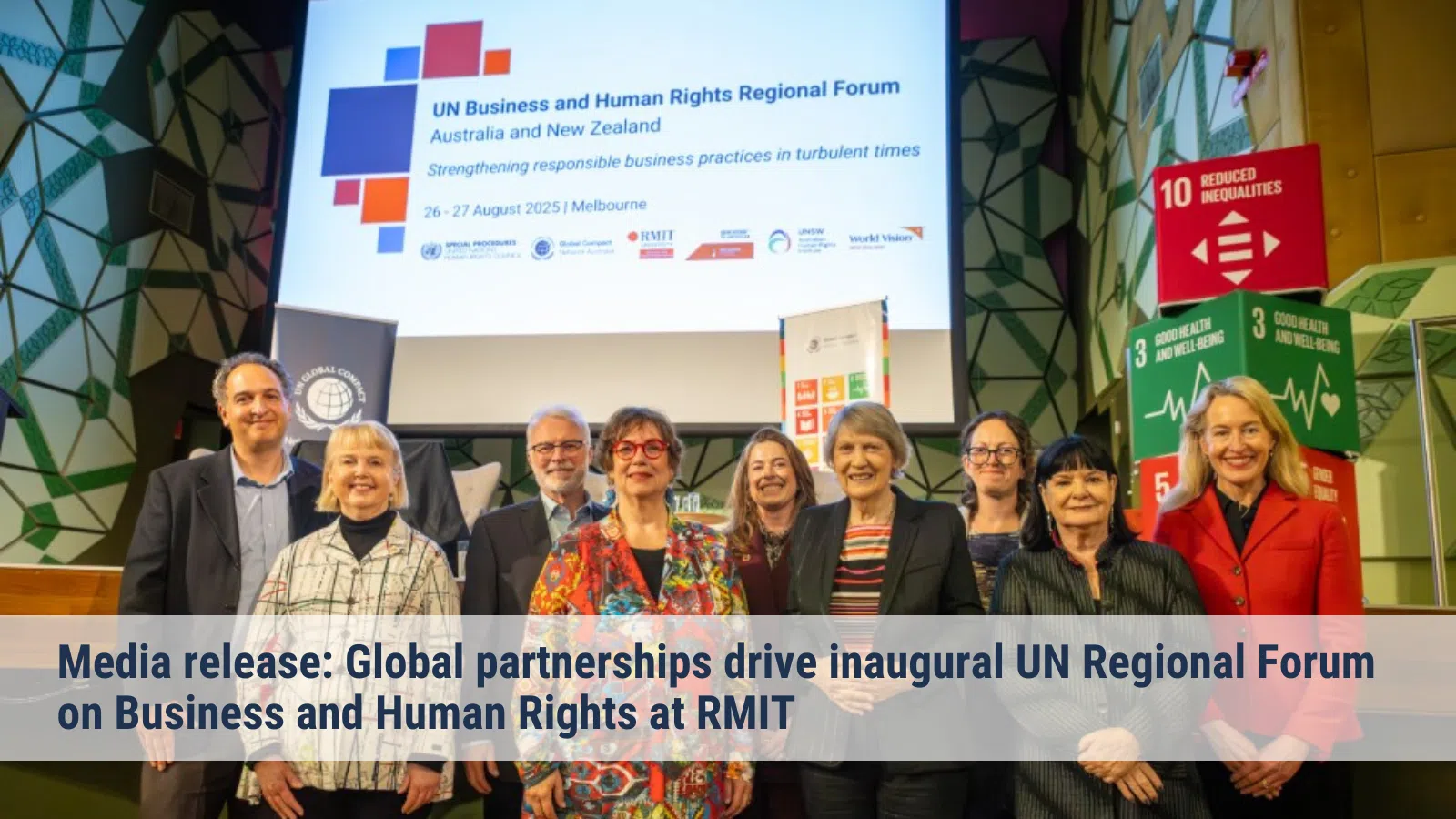
UN Global Compact Network Australia, in partnership with the United Nations Working Group on Business and Human Rights, RMIT University, Macquarie University, UNSW, and World Vision New Zealand hosted the first-ever United Nations Business and Human Rights (UN BHR) Regional Forum: Australia and New Zealand on August 26-27.
Held at RMIT’s Storey Hall, the forum brought together leaders from government, business, academia, civil society, and the investment sector to explore how businesses can better respect and promote human rights in a rapidly changing global landscape.
Catie Shavin, Senior Manager at UN Global Compact Network Australia said:
“This inaugural forum is a powerful opportunity to elevate the conversation around business and human rights in our region. As we navigate increasingly complex global challenges, it’s vital that businesses lead with purpose and embed a risk-based approach to human rights.”
Associate Professor Jonathan Kolieb, Director of RMIT’s Business and Human Rights Centre (BHRIGHT) added:
“Human rights are at the centre of our understanding and respect for humanity, and business is at the core of this. The forum showcased the impact achieved and achievable in the business and human rights space, with human rights-aligned leadership.”
Driving dialogue and action
At the forum, attendees discussed key trends and developments in the business and human rights landscape in our region and globally.
Across two days, attendees engaged in discussions on:
- Ending modern slavery through legislative reform
- Strengthening human rights due diligence
- Elevating Indigenous rights in the economic transition
- Harnessing responsible AI
- Enabling positive outcomes across global supply chains
- Enhancing access to remedy mechanisms.
Speakers included:
- Robert McCorquodale, Member, UN Working Group on Business and Human Rights
- Chris Evans, Australian Anti-Slavery Commissioner
- Jane Duke, Australia’s Ambassador to Counter Modern Slavery, People Smuggling and Human Trafficking
- Lorraine Finlay, Human Rights Commissioner, Australian Human Rights Commission
- Dr. James Cockayne, New South Wales Anti-Slavery Commissioner
- Allan Jørgensen, Director, OECD Centre for Responsible Business Conduct
- Professor Gail Pacheco, New Zealand Human Rights Commission
- Keren Adams, Legal Director, Human Rights Law Centre.
A plenary event to address the contemporary era of change
The forum culminated in a public plenary session, Human Rights, Business and Turbulent Times: Challenges, Responsibilities and Opportunities, hosted by RMIT Chancellor Peggy O’Neal AO. The session featured a fireside chat with:
- Helen Clark, former Prime Minister of New Zealand
- Sharan Burrow, former ACTU President
- Linda Kromjong, President of amfori
The conversation focused on how business and society can respond to the uncertainty and disruption of today’s global environment.
Attendees also heard from renowned international lawyer and business and human rights expert Robert McCorquodale.
The event was the first certified fully sustainable event at a university in the Australasian region, achieving the first three-star certification.
The Australian Campuses Towards Sustainability (ACTS) Sustainable Events Accreditation supports event organisers across Australasia to embed sustainability into every aspect of their event planning. The certification provides a clear and practical framework to help reduce environmental impact, promote social responsibility, and showcase leadership in sustainable event delivery.
More information about the forum is available here: https://unbhrforumanz.org/
Photo (from left to right): RMIT Associate Professor Jonathan Kolieb, RMIT Chancellor Peggy O’Neal AO, Robert McCorquodale, Linda Kromjong, UNGCNA Kate Dundas, Helen Clark, UNGCNA Catie Shavin and Sharan Burrow.


article by
Emilia Maubach
Emilia is a marketing, communications, and events leader with a distinctive combination of legal expertise and a strong focus on sustainability and international relations. Her career spans the legal sector, major global sporting events such as the Australian Open and Wimbledon, and transformative sustainability initiatives, giving her a global outlook and a commitment to integrity, inclusion, and responsible business practices. Emilia holds a Bachelor of Arts in International Relations and Languages, a Master of Laws (admitted to practice), and a Mini MBA in Marketing. Fluent in German and proficient in Spanish, Emilia creates impactful experiences that elevate voices, build connections, and drive meaningful change.