

UN Climate Change
Conference - COP31
For short, COP31 – or the UN Climate Change Conference – will be held from 9 to 20 November this year in Antalya, Türkiye.
Here’s what you need to know.
What is a COP?
A COP, or Conference of the Parties, is the supreme decision-making body of the United Nations Framework Convention on Climate Change (UNFCCC). It brings together all countries (“Parties”) that have signed onto the Convention to review progress, negotiate agreements, and take decisions that advance global climate action.
The acronym ‘COP’ is a UN legal term used for any treaty body composed of “parties” to that treaty (there are several different COPs across the UN system and its conventions, including the Centre for Biological Diversity COP, which produced the Kunming-Montreal Global Biodiversity Framework),
While several UN treaties have ‘Conferences of the Parties,’ the term ‘COP’ is most commonly understood as the annual UN Climate Change Conference under the UNFCCC.
The COP has become synonymous with international climate action and includes milestones like the Paris Agreement (COP21) and other important initiatives such as the Kyoto Protocol – both of which had significant private sector support.
How often and where are COPs held?
COP meetings are held annually and the COP Presidency rotates among the five recognised UN regional groups (Africa; Asia; Latin America and the Caribbean; Central and Eastern Europe; and Western Europe and Others), with Australia and Türkiye falling into the Western Europe and Others group.
COPs are typically held in November each year in the host city, with mid-year meetings held in Bonn at the UNFCCC headquarters between the annual conferences.
At each COP, governments assess how effectively the world is addressing climate change—reviewing emissions data, national commitments, and the implementation of previous decisions.
A mandate for business engagement via the Marrakech Partnership for Global Climate Action (MPGCA)
The Marrakech Partnership, launched during COP22 in 2016 and under the leadership of the Climate High-Level Champions, supports the implementation of the Paris Agreement (adopted at COP21) by enabling collaboration between governments and non-Party stakeholders such as cities, regions, businesses, investors, and civil society including youth, Indigenous Peoples and local communities to act on climate change. The MPGCA’s mission is to strengthen collaboration between actors to lower emissions and increase resilience against climate impacts, promoting higher ambition to collectively strive for the 1.5 °C temperature goal and a climate-neutral and resilient world.
There is a clear mandate for private sector engagement in COPs through both the Marrakech Partnership and through collaboration with the UN Global Compact’s network of UN agencies such as the UNFCCC.
How does COP function?
While each COP is different, there are three logistical components to each COP.
- Negotiations: The first are the formal negotiations, where global initiatives like the Paris Agreement (COP21) were established. Multilateralism is key to productive outcomes, and despite geopolitical tensions, the parties that came to COP were very engaged in discussions.
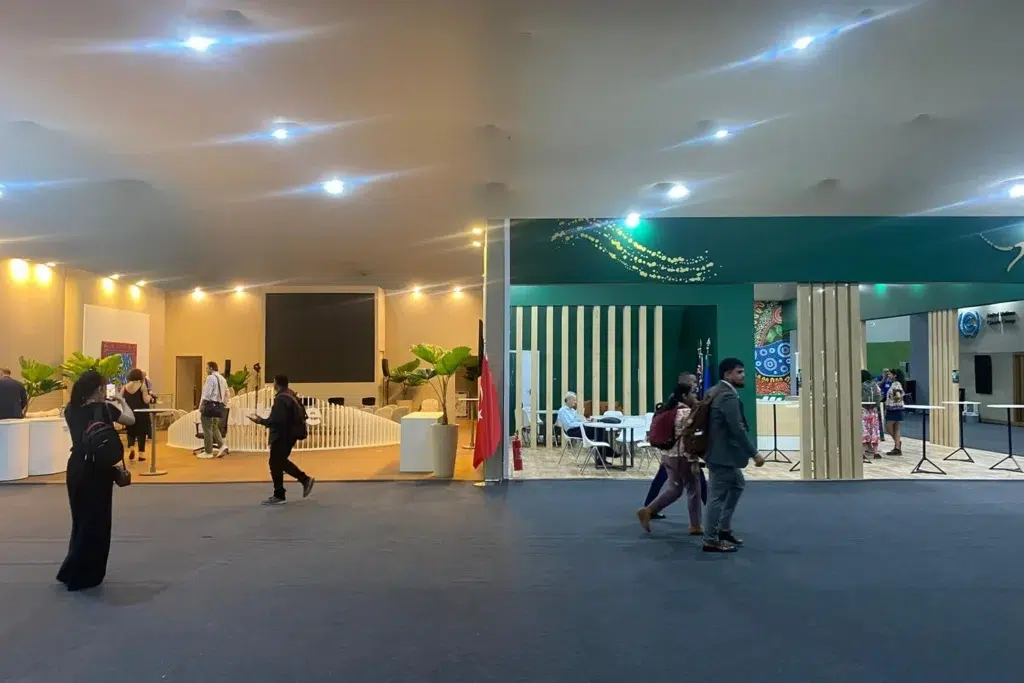
- Blue Zone: The Blue Zone is the larger restricted area that houses negotiations but also functions much like a large conference. It houses pavilions where conference activities such as speaker panels and side events, high-level discussions, and other conference events take place.
- Green Zone: This area is open to the general public. It can be conceptualised as more of the trade and exhibit area of a conference, which also extends the conference-type activities that occur within the blue zone.
In simple terms
A COP is where the world comes together to negotiate and decide how to tackle climate change.
The key elements of COP31
- Presidency – Türkiye
- Presidency for negotiations – Australia
- Action Agenda – negotiated between Australia and Türkiye
- Pre-Cop in the Pacific – a Pacific Resilience Fund pledging event
- COP31
How can businesses engage with COP31?
Australian businesses will have a key role to play in progressing ambitious goals for climate and nature, with a spotlight on Australia’s pivotal role as President for Negotiations.
UNGCNA activities throughout 2026 and in the lead-up to COP31 will have a strong focus on understanding and championing participant priorities, to feed into the COP31 agenda.
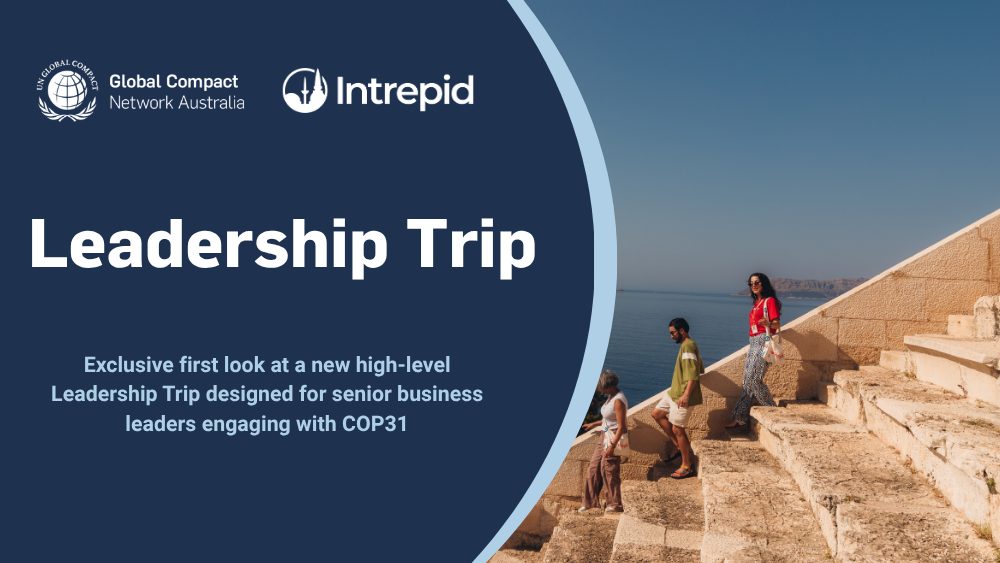
To mark this special Australia-Türkiye COP31, we will be hosting our inaugural Leadership Trip with our Founding Supporter Intrepid Travel – taking our participating companies to Antalya on a small group trip in the days prior to COP31. This experience will bring together a select group of leaders, shepherding the COP31 experience.
Who are the key players & what are their roles?
UNFCCC
The Global Framework
- Oversees global climate negotiations under the Climate Convention and Paris Agreement.
- Sets the rules and structure for all COPs.
- Coordinates the process with 198 Parties worldwide.
Think of it as: The global system that makes climate negotiations possible.
Türkiye
COP31 Host & COP President
The Official Host
- Hosts COP31 in Antalya, including the World Leaders’ Summit 11-12 November 2026.
- Holds the formal title of COP31 President.
- Manages logistics, operations and communications for the event.
- Appoints the UN High-Level Climate Champion and Youth Champion.
Think of it as: The official host, ceremonial and logistical leader of COP31.
Australia
Presidency for Negotiations
The Global Dealmaker
- Holds exclusive authority over COP31 negotiations.
- Leads the negotiation agenda from end of COP30 to end of COP31.
- Works closely with Türkiye to align political and technical processes.
- Partners with Pacific nations to advance regional climate priorities.
Think of it as: Shaping the global climate deal.
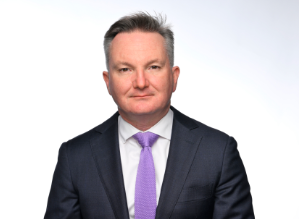
The Hon. Chris Bowen MP, Minister for Climate Change and Energy – President of Negotiations
The Lead Negotiator
- Personally leads all COP31 negotiations.
Holds the negotiation gavel and issues draft text and decisions. - Selects ministers and co-facilitators for negotiation tracks.
- Advances priorities on finance, energy transition, and Pacific resilience.
Think of it as: The chief architect of COP31 outcomes.
DCCEEW
Australia’s Negotiation Engine Room
- Develops negotiation strategy and supports the Minister.
- Coordinates intergovernmental and international engagement.
- Runs the UNFCCC Stakeholder Engagement Hub.
- Provides technical, policy and scientific advice across all COP issues.
Think of it as: The team powering Australia’s COP31 diplomacy.
“Leading the COP31 negotiations in partnership with the Pacific will strengthen our ties with our closest neighbours, raising our region’s profile in support of shared prosperity, stability and security.”
“I do think maybe we have hit upon something special that might become more of a model going forward. If you think the world needs countries to come together, Australia and Türkiye with our rich but complicated history over more than a century – two quite different countries … can come together – that’s pretty powerful message to say, well if we’ve been flexible and we’ve put the world first, maybe you can too…”
“The Antalya World Leaders Summit is as “a moment to demonstrate true, practical global cooperation”
COP31 agreed modalities
Read the final negotiated modalities on the UNFCCC website: 20251121_COP31_Presidency_Modalities-CLEAN-AGREED.pdf
UNGCNA roadmap for business to COP31
| Date | Event/engagement | Location |
| 23 Feb | UNGCNA 2026 Kick-off event (participant only, invite-only) | Melbourne, Australia |
| 4 March | UNGCNA program launch | Online |
| 9-15 March | Climate Action Week | Sydney, Australia |
| 28-29 April | First International Conference on the Just Transition Away from Fossil Fuels | Santa Marta, Colombia |
| 13-14 May | Uniting Business LIVE Australia | Sydney, Australia |
| 8-18 June | UNFCCC SB64 (mid-year climate meetings) | Bonn, Germany |
| 16-18 June | UN Oceans Conference | Kenya |
| 6-15 July | High-Level Political Forum | New York |
| 21-25 September | UN Global Compact Hub (during UN General Assembly week), including the UN Global Compact Leaders Summit | New York |
| 30 September | UNGCNA Roundtable (invite only) | Sydney, Australia |
| 30 September | UNGCNA Networking evening | Sydney, Australia |
| 1-3 October | Pre-COP31 Australia & Pacific Youth Climate Dialogue (APYCD) | Nadi, Fiji |
| 5-8 October | Pre-COP in the Pacific | Fiji |
| 13 October | From the Pacific to Antalya: What business needs to know about COP31 | Online |
| 5-9 November | UNGCNA Leadership Trip | Antalya, Türkiye |
| 9-20 November | COP31 | Antalya, Türkiye |
| 1 December | COP31 APAC webinar | Online |
From COP30 to COP31
Nature and biodiversity sparkled at COP30, which was strategically placed in the Amazon.
We saw progress on global finance, just transition efforts, gender, Indigenous engagement and potential global roadmaps away from both deforestation and fossil fuels.
In terms of negotiation outcomes, the major items of discussion were a roadmap away from both fossil fuels and deforestation. While Brazil made some big announcements, especially regarding the latter, there is still much work to do to implement these pathways and mechanisms have been established to keep global discussions continuing. Global discussions on just transition also progressed.
In terms of negotiation outcomes, the major items of discussion were a roadmap away from both fossil fuels and deforestation. While Brazil made some big announcements, especially regarding the latter, there is still much work to do to implement these pathways and mechanisms have been established to keep global discussions continuing. Global discussions on just transition also progressed.
Private sector involvement at COP31
- The private sector has a massive role to play and discussions on adaptation and business resilience in a changing climate were salient throughout COP. Indeed, with the emergence of renewables (i.e. cheap energy), we are seeing major economies start to embrace energy security for the first time. This occurs at a time when climate-related issues, such as climate disasters and multilateral breakdowns, are driving increased business risk.
- Transparency is a mechanism by which collective national climate action plans (or NDCs) display progress towards the mitigation efforts of the Paris Agreement. As transparency mechanisms increase globally for the private sector (e.g. climate reporting) the impacts on tangible private-sector outcomes for climate action at the state level will be more easily measured and managed.
- Notably, many leading businesses were showcasing nature-positive progress in their own operations. Meaningful business engagement with First Nations communities was at the forefront of COP30. There will be much work to be done here as Australia leads COP31 negotiations.
The Pacific Resilience Fund
A Pacific-owned and led solution, the Pacific Resilience Fund (PRF) is an initiative aimed at enhancing climate resilience and disaster preparedness in Pacific Island communities, focusing on sustainable financing and local empowerment. The PRF treaty was signed at the Pacific Islands Forum Leaders Meeting in 2025. In development for over a decade, its establishment is seen as a game-changer for climate action in the region. It will be a key focus of the Australian Government for COP31, and we will bring more information forward as it becomes available.
“I am very proud of the Australian businesses that showed up for COP30 and pushed for sustainable business action. Here at the UNGCNA, we continue to provide Australian businesses with the tools and forums they need to progress business ambition via our accelerators, consultations, roundtables, dialogues, communities of practice and conferences. Join us as we move towards COP31!”
Keen to dive deeper?
Check out these resources (if you’ve got one you’d like to add, please contact us)
Podcasts
- Interview with COP31 President for Negotiations, The Hon Chris Bowen MP “It’s 9,058 Miles To Antalya, We’ve Got A Fraught Negotiation Agenda, Half A COP Presidency, Multilateralism Is On The Ropes, And We’re Wearing Sunglasses.” “Hit it.”
Private sector
- Modelling Sectoral Pathways to Net Zero | CSIRO
- EY Global Climate Action Barometer Australia’s next climate move: from targets to transition | EY – Australia
- Guide to Corporate Credibility for Climate Transition Plans | Climateworks Chambers of Commerce
- COP31 to be hosted by Türkiye with Australia leading negotiations – Australian Turkish Chamber Of Commerce
Upcoming UNGCNA Events
2026
Optimising stream | Modern Slavery Community of Practice
2026
UN Global Compact Singapore Summit 2026
2026
Implementing + SME stream | Modern Slavery Community of Practice
2026
UN Global Compact Leaders Summit 2026
2026
Spotlight Session | Sustainability Reporting Community of Practice
2026
SDG Flag Day 2026
2026
Human Rights Due Diligence Workshop: What does it take to transform business practices in global supply chains?
2026
2026 Australian Dialogue on Business and Human Rights
2026
Peer Learning Session | Sustainability Reporting Community of Practice
2026
Leadership Trip