Blogs
COP31: Business cannot afford to wait for consensus
Dr Evan Center | November 24, 2026
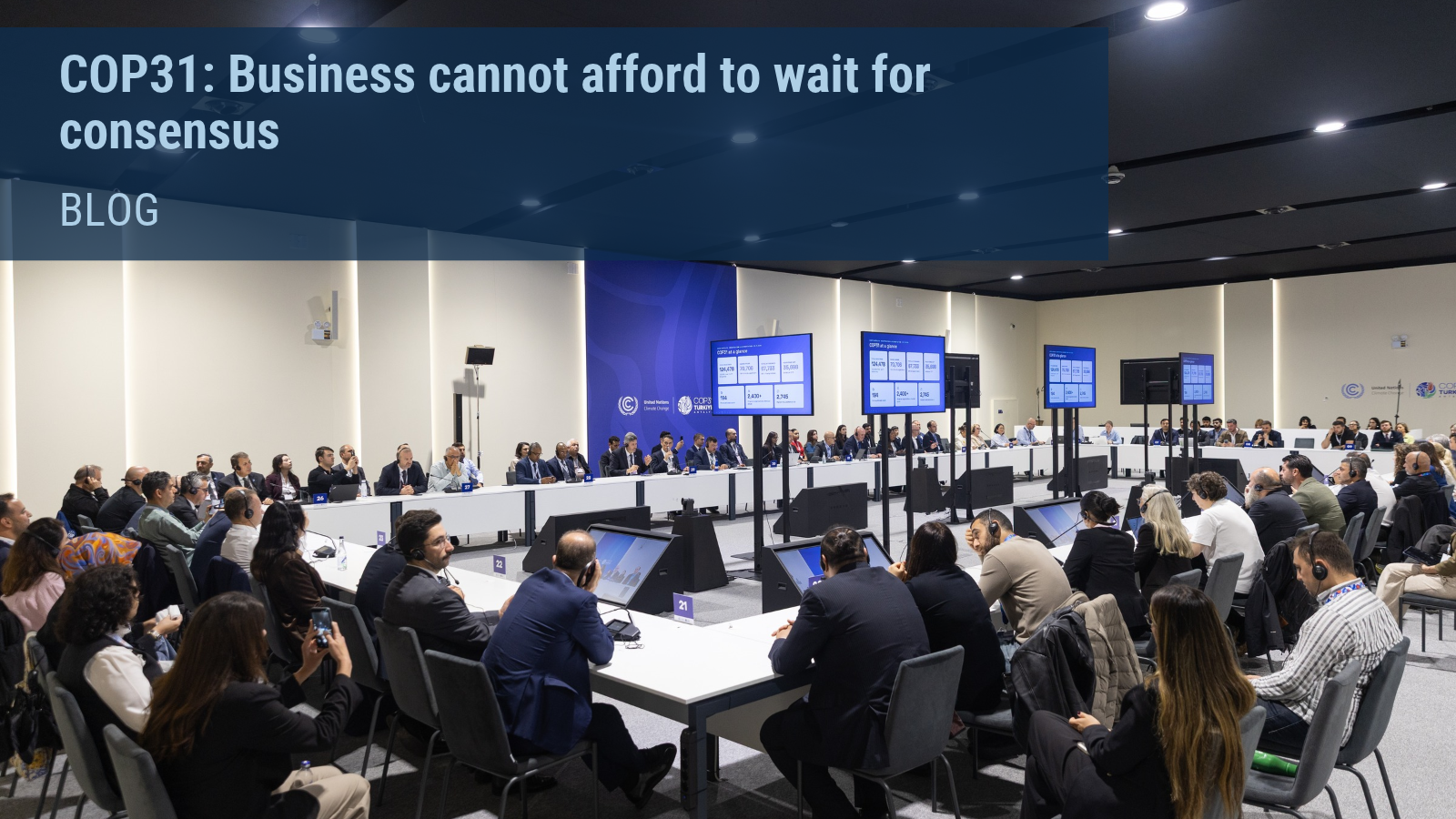
This year’s 31st Conference of the Parties to the United Nations Framework Convention on Climate Change – COP31 – (commonly referred to as the UN Climate Change Conference) was positioned as a COP of implementation. Instead, it ended without the overarching agreement that many had hoped for and exposed deep divisions over fossil fuels, climate finance and the pace of transition.
Within the final plenary, the anger and frustration among countries and communities already experiencing the escalating impacts of climate change were indeed tangible. At a moment when the world urgently needed coordinated action, the negotiating process failed to deliver political consensus on a highly-anticipated cover draft.
While the failure to reach an overarching agreement was disappointing, COP31 nevertheless delivered decisions in specific negotiating areas and demonstrated momentum in several important areas of climate action that are particularly important for the private sector.
With Australia’s primary non-negotiation announcements focused on regional economic opportunity, Australian and global business leaders can carry momentum towards strengthened business resilience as they better manage climate-related risks; accelerate electrification-driven economic opportunities; and engage governments on the economic partnerships needed for the net-zero transition.
Clean energy transition and electrification: 35 by 35
The clearest sign of momentum was the 35 by 35 Global Electrification Pledge, which was launched by the COP31 Presidency in New York in September. The pledge aims to lift electricity’s share of global final energy consumption from around 23% today to 35% by 2035. By the close of COP31, more than 150 countries and 250+ global businesses were involved, with Australia among the first signatories.
As Minister Bowen said, “On electrification, Australia supports, and I support the 35 by 35 pledge” and that “there is strong momentum behind it.”
The pledge is voluntary, and each country sets its own path, but it is supported by a practical Electrification Delivery Package that includes a Global Electrification Tracking Mechanism. Notably, UN Global Compact Network Australia (UNGCNA) participants such as IKEA, Intrepid Travel and Fortescue signed the aligned We Mean Business statement that calls for 35% electrification by 2035.
Electrification backed by renewables did not bring about consensus, but it did show real momentum at COP31. Affordable, reliable energy underpins decarbonisation, competitiveness and enterprise resilience and electrification delivers all three – while lifting productivity, creating decent jobs and building new industries. For business, electrification is increasingly a strategy for competitiveness.
One example of the momentum around global electrification was showcased in the Australia–Korea Memorandum of Understanding (MoU) on a Joint Decarbonisation Pathway, which was signed on the sidelines of COP31. The pathway aims to connect Australia’s renewable energy and resources with Korean industrial demand as Korea moves away from imported fossil fuels – and covers investment in clean energy and net zero industries, more secure supply chains, cooperation on green metals, hydrogen certification, critical minerals and green shipping. From a larger economic lens, the MoU also positions Australian business to take part in Korea’s KRW 1,000 trillion (AUD$1.12 trillion) green transformation strategy. As Minister Bowen explained: “Combining Australia’s renewable energy resources and industrial strengths with Korea, we can attract investment, build stronger supply chains and create secure, well-paid jobs.”
The move away from fossil fuels is especially important to business, as geopolitical conflict has again exposed the vulnerability of global energy markets: fuel-importing countries faced around US$330 billion (AUD$497 billion) in additional costs between March and August this year, and many businesses were left scrambling. In a volatile market, energy sovereignty is now a business need, not a policy aspiration.
In September this year, the UN Environment Programme’s (UNEP’s) report Limiting Overshoot: Navigating exceedance of 1.5°C and pathways towards return confirmed the world will exceed 1.5°C; even in its most optimistic scenario, with all current national climate plans and net zero targets implemented, it sees warming peak at around 1.8°C. Overshoot is not surrender, and the smaller and shorter it is, the more Australian business protects its assets, supply chains and growth in a rapidly changing environment.
That is why there has been strong cross-sectoral alignment that 1.5°C remains good for Australian business, and decisions by business to decarbonise can uplift economies, subsequently drive business resilience, and mitigate further global climate disruption. For Australian business, successful organisations will need to quickly adapt, build resilience and seize the opportunities emerging from the transition.
Watch this space for business momentum ahead of COP32
With the close of COP31, Türkiye and Australia continue to lead throughout this Presidency year and in the official handover to the next Presidency at COP32. As Brazil showed after last year’s COP30 in Belém, the year after COP carries momentum. Just as Brazil delivered a roadmap to phase out fossil fuels at COP31 – as an outgrowth of the 2026 First Conference on the Transition Away from Fossil Fuels (TAFF) –Australia and Türkiye will carry momentum forward into the next UN Climate Change Conference in Addis Ababa, Ethiopia.
Here are some things to watch for between now and November 2027:
- New opportunities for investment, exports and industrial collaboration.
As global businesses are increasingly exposed to a volatile energy marketplace, keep an eye on what other electrification partnerships emerge between Australia and its regional neighbours. For instance, as COP31 headed into overtime, Beijing reiterated Australia and China’s joint climate and clean-energy ambitions. For Australian companies, these partnerships can unlock new markets, strengthen supply chains and improve access to clean-energy inputs critical to future competitiveness.
- Businesses must plan for an uneven and politically contested energy transition.
Fossil fuels were the breaking point of COP31. The EU, Panama and others refused any outcome that did not acknowledge a transition away from fossil fuels, while Russia and Saudi Arabia were among those opposing that language. Speaking for the EU, Ireland’s Climate Minister Darragh O’Brien said: “It’s unconscionable that we would have a climate act that makes no reference to fossil fuels.”
- Translating financial frameworks and mechanisms for transparency and investable projects.
A strong focus on finance for adaptation will likely flow into COP32. Continued discussion around the Climate Implementation Bridge (CIB), an initiative launched by the COP31 Presidency (Türkiye) with the United Nations Development Programme (UNDP) to help countries turn national climate plans into bankable, investment-ready projects.
Discussions on Article 9 (the legal backbone behind international climate funding debates, originating from the Paris Agreement) and Article 2.1(c) (addressing the alignment of the entire global financial system, a core long-term goal of the Paris Agreement) will feed into the uptick of global climate reporting frameworks (e.g. mandatory climate-related financial disclosure) and ideally support mechanisms that can turn promised capital into tangible projects.
Businesses should expect increased interest in their climate-related risks and opportunities from investors, lenders and regulators alike.
- Businesses need to address workforce, human rights and community impacts now
Speaking on behalf of the African Group, Ghana acknowledged shortcomings in areas including climate finance, loss and damage and the just transition, which it said received “a single generic sentence.”
While COP31 adopted a decision on the Just Transition Work Programme that keeps the just transition mechanism agreed at COP30 within the process, decisions on its structure and functions were deferred to COP32. Expectations around workforce transition, social impact and stakeholder engagement will continue to grow.
Parties, including business, can submit views on what the mechanism should do and how it should operate until 15 March 2027. This can be done in one of three ways:
- Business associations, industry groups or chambers of commerce with admitted observer organisations via the UNFCCC Submission Portal
- Individual businesses without observer status via email to the UNFCCC secretariat at submission-info@unfccc.int please note the mandatory formatting rules available on the UNFCCC Submission Portal
- Through business constituencies (joint submissions), most notably BINGO (Business and Industry Non-Governmental Organizations), the official UNFCCC business constituency, or sector-specific observer associations.
For business, a just transition is not something to be deferred. It requires decisions now. Decisions about decent work, skills, responsible supply chains, human rights and meaningful engagement with affected communities, including First Nations peoples. In our region, it also means recognising the urgency of adaptation and resilience for Pacific communities and ensuring that climate finance reaches the places where it is most needed.
Business is where implementation happens
Business support helped make Paris and Glasgow possible, and business will make momentum around implementation possible. Across the global economy, businesses of every size are electrifying their operations, building green industry and reporting on climate risk. Businesses are turning global commitments into measurable action, and they are ready to do more.
With company directors now thoroughly aware of climate-related risks and opportunities, Australian business needs clear, consistent policy and constructive engagement with government. But businesses also have a responsibility to support the policies needed for the transition, including through their own advocacy and the positions taken by industry associations on their behalf. Australia’s mandatory climate reporting regime offers up one model of how the Paris Agreement (e.g. Article 2.1(c)) can help companies identify and mitigate climate risk, uncover new market opportunities, and give investors the consistent information they need to invest with confidence.
As UN Climate Change Executive Secretary Simon Stiell explained in Antalya: “Nations now face a choice: electric or shock.” Government and private sector engagement and practical support can turn electrification and climate ambition into a world-leading opportunity to accelerate climate action with businesses of every size, from small enterprises to major industry. Investment in clean energy, grids, storage and skills will underpin it, and workers and communities must share the benefits.
Business leadership must now extend beyond commitments and opportunity. This means working with suppliers to reduce emissions and build resilience; supporting credible and consistent climate policy; leveraging climate reporting efforts and transparency and enterprise resilience; and ensuring industry associations represent the actual positions of the companies for which they advocate. This also means ensuring that workers, communities and vulnerable countries share the benefits of the transition.
The failure to reach consensus at COP31 does not diminish the business case for action. If anything, it strengthens it. In a world of increasing climate, geopolitical and energy-system disruption, resilience, competitiveness and growth will belong to organisations that move early. Now is the time to identify climate-related risks, accelerate electrification, engage constructively on transition policy, and invest in the capabilities needed to compete in a lower-emissions economy. Governments may disagree on the pace of change, but business cannot afford to wait.
The UNGCNA is here to support Australian businesses
This year the UNGCNA sent a delegation to Antalya, Türkiye for COP31, which included several of our business participants and staff including Young Professional representation. In doing so, we were able to support our businesses with direct government engagements, opportunities to share ideas throughout the blue zone, and the ability to connect with our regional and global networks. With the benefit of joining business leaders on the ground, the UNGCNA will continue to support private sector momentum following COP31 and in the lead-up to COP32.