Blogs, Environment & Climate Change, Featured
COP31 Business Roundtable: From information integrity to implementation
Dr Evan Center | November 2, 2026
With Australia serving as Presidency for Negotiations at UNFCCC 31st Conference of the Parties (COP31), increased attention has turned to how climate ambition can translate into practical outcomes.
For business, COP31 offers an opportunity to understand emerging policy and market signals, build strategic relationships and bring global insights back into organisational decision-making.
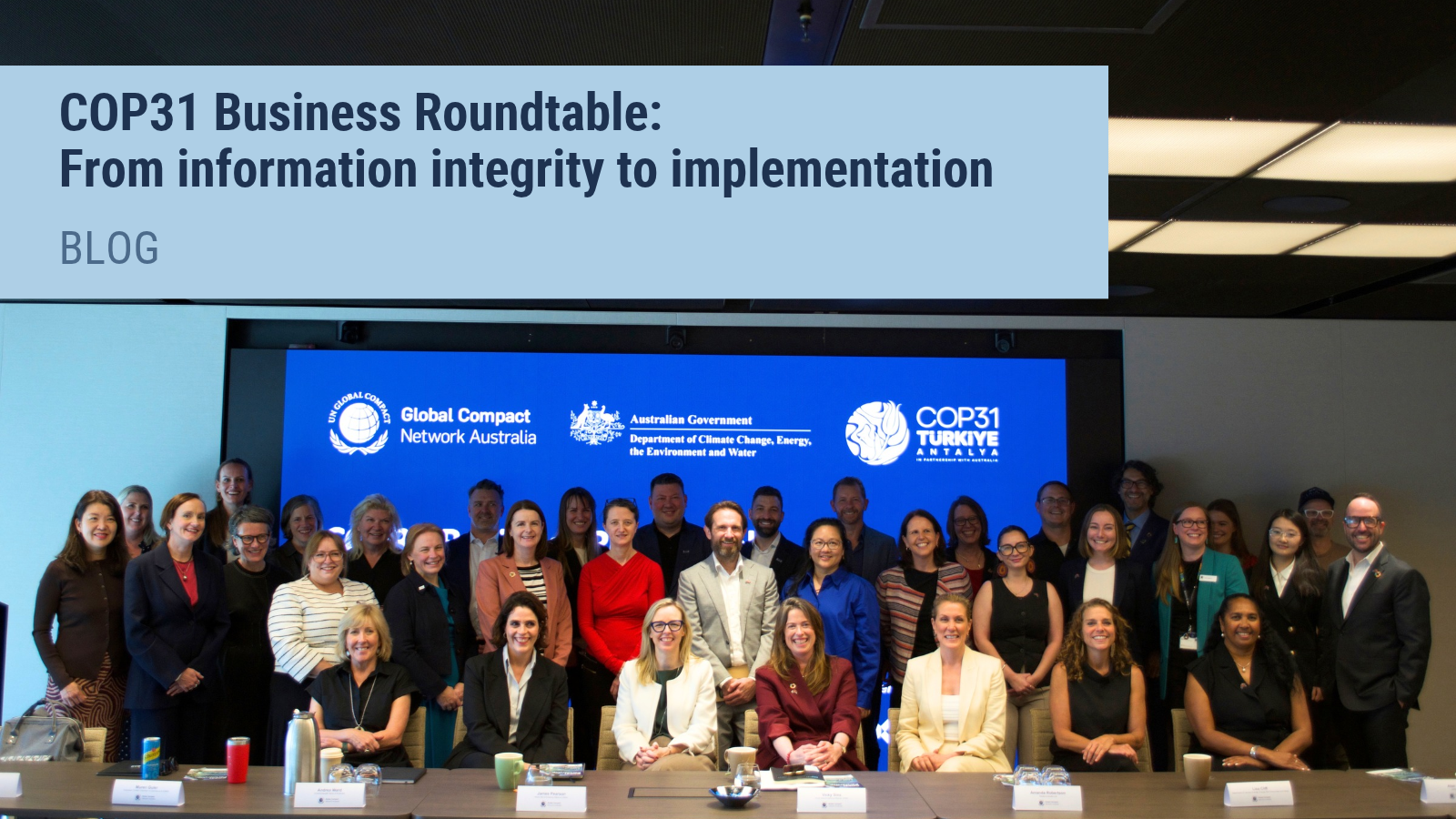
On the 30th of September 2026, the UN Global Compact Network Australia (UNGCNA) convened the COP31 Business Roundtable in Sydney as part of its COP31 business engagement.
Hosted by the ASX and held in collaboration with the World Benchmarking Alliance (WBA), the Principles for Responsible Investment (PRI) and the Department of Climate Change, Energy, the Environment and Water (DCCEEW), the roundtable brought together more than 30 senior representatives from business, government, investment and civil society.
Discussions explored how business can strengthen information integrity, build trust and support credible implementation ahead of COP31.
While at previous roundtables UNGCNA participants have expressed that a “1.5°C world is best for business,” it is increasingly clear that that the target has been breached and global climate action must turn to how quickly temperatures can be stabilised and brought back down.
According to UNEP’s 2026 Limiting Overshoot report, exceeding 1.5°C is now widely assessed as unavoidable, with lower peak warming and shorter overshoot periods critical to reducing climate risks and avoiding irreversible impacts.
For business, the Limiting Overshoot report points to growing risks from heat-related productivity losses, pressures on food and water systems, supply chain and infrastructure disruption, and increasing physical asset damage, while highlighting the role of adaptation and resilience investments in reducing economic losses.
These risks are no longer long-term and underscore the need to move beyond commitments and accelerate implementation through robust transition planning, investment in decarbonisation, adaptation and resilience, and clear accountability for delivering measurable outcomes.
Notably, the private sector is crucial to a successful COP process. The most successful COPs – from Kyoto (COP3) to Paris (COP21) to Glasgow (COP26) – delivered landmark agreements that advanced global climate action, with business playing a pivotal role.
COP31 presents a similar opportunity for Australian business to demonstrate leadership, strengthen economic competitiveness, and help accelerate climate action at home and abroad.
As the private sector gears up towards one of the largest COPs ever, with an implicit focus on implementation via private sector support, there are a number of avenues through which the private sector can support successful outcomes. Action agenda items such as electrification backed by renewable energy, green industrialisation and the Climate Implementation Bridge are all key areas where business can positively impact, and even accelerate, climate action.
Roundtable Areas of Focus
- Business commitment and transition risks
Business leaders continue to recognise the risks of a disorderly transition. The 2025 UN Global Compact–Accenture CEO Study – which pulled insights from nearly 2,000 CEOs – found that 99% intended to maintain or expand their sustainability commitments. The World Business Council for Sustainable Development’s (WBCSD) Business Breakthrough Barometer 2026, based on responses from more than 500 senior business leaders, found that 98% considered a disorderly transition a risk to their business and 47% of companies had experienced higher costs from physical climate impacts in the previous year.
These findings point to sustained business commitment, but also growing exposure to disruption. Clear policy signals and reliable information can help companies assess risk, allocate capital and plan with greater confidence. Delays make that task harder and can increase the cost of future adjustment.
- Defining climate misinformation
Climate misinformation is used as an umbrella term covering misinformation, disinformation and malinformation: false information shared unintentionally, deliberately false information, and accurate information used to mislead. These forms of information disorder can undermine informed public discussion and confidence in climate and energy policy, creating practical risks for policy delivery and the energy transition.
- Climate misinformation as a business risk
In Australia, misinformation narratives are increasingly focused on delaying or disrupting climate and energy action rather than denying climate change itself, often centring on costs, energy reliability, jobs and local impacts.
The Climate Change Authority’s Misinformation: A climate policy risk report finds that these narratives are already affecting climate policy delivery in Australia, contributing to project delays, higher costs and community division. For businesses, this can weaken investment confidence and make it harder to explain what the transition means for customers, employees and communities.
Responding requires companies to address practical concerns as well as communicate evidence. Clear, evidence-based communication can support more informed discussion, particularly where uncertainty about specific projects or policies affects public confidence.
- Strengthening trust through business action
Despite strong levels of commitment, businesses also face a preparedness gap. The CEO Study found that fewer than 14% of CEOs felt well prepared for challenges including inflation, trade regulation and climate change, while only 26% had dedicated scenario-planning teams. Reliable information and the capacity to use it are essential to navigating these pressures.
Australia’s mandatory climate-related financial disclosure (CRFD) regime provides a practical foundation for more credible climate information. Under AASB S2, entities within scope are required to disclose material climate-related risks and opportunities across governance, strategy, risk management, metrics and targets. Scenario analysis helps companies assess their resilience under different climate futures.
ASIC’s early observations found improvements in the quantity and quality of climate-related financial information compared with previous voluntary disclosures, with standardised requirements driving greater consistency and comparability. Stronger reporting can help boards understand exposure, support investment decisions and give stakeholders a clearer picture of transition readiness.
Information integrity also extends to public communication. Research commissioned by companies, the assumptions underpinning it and positions taken through industry associations all influence understanding. These should be consistent with corporate climate commitments and supported by evidence, with uncertainties and remaining challenges clearly explained.
Themes and takeaways from the roundtable
- From ambition to implementation to acceleration: The focus is shifting from setting commitments to delivering them rapidly through capital allocation, operational decisions and credible transition plans.
- Trusted and relevant information: Climate communication needs to use trusted voices and connect with practical concerns such as energy costs, insurance, jobs and livelihoods.
- Making progress visible: Capital allocation, operational change and measurable outcomes can show whether climate commitments are translating into real-world action.
- Disclosure as a decision-making tool: Climate reporting can strengthen governance, risk management and investment decisions when it is used beyond compliance.
- Barriers beyond technology: Approvals, financing, policy certainty and stakeholder coordination can constrain delivery as much as technology itself.
- Community participation and trust: Early engagement, including with First Nations communities, can strengthen project outcomes and give communities greater agency in transition.
- Connecting climate, nature and social outcomes: Transition planning increasingly needs to consider nature, human rights and community impacts alongside decarbonisation.
- Transparency about trade-offs: Acknowledging costs, constraints and unresolved challenges alongside progress can strengthen trust and support more informed discussion.
Looking ahead to COP31
As Australia takes its leadership role at COP31, the UN Global Compact Network Australia encourages momentum between the private sector and government in five priority areas:
- Make information integrity for corporates and investors a core enabler of climate implementation
Recognise and showcase trusted, accessible and evidence-based information as a critical enabler of climate action, particularly where major decisions affect investment, infrastructure, communities and households.
- Leverage Australia’s role in the COP31 Presidency year to demonstrate how climate reporting drives implementation outcomes
Build on Australia’s significant experience in climate disclosure and transition planning by demonstrating how high-quality reporting can inform board decision-making, strengthen investor confidence, improve capital allocation and accelerate practical decarbonisation outcomes at corporate, national and global levels. While the reporting burden and initial learning curve for business should indeed be recognised and addressed, greater government support and stronger alignment across departments can help build capability, reduce duplication and maximise the recognised commercial and economic value of climate reporting for business resilience and competitiveness – while also providing the transparency necessary to expedite decarbonisation efforts.
- Strengthen the credibility and coherence of business action
Encourage businesses to align what they disclose, what they communicate, what they advocate for and where they invest, so that corporate climate commitments are supported by consistent action. Government can convene, support, and encourage Australian businesses to align their commitments, advocacy, and affiliations to deliver successful COP31 outcomes.
- Build trust through communities, not around them
Engage First Nations peoples, workers, regional communities and affected stakeholders early, and support communities to shape and communicate their own transition stories. This early engagement is good for business as well as for communities and government.
- Make the investment value of climate disclosure visible through stronger investor-corporate engagement
Enable investors, asset owners and fund managers to demonstrate how corporate climate disclosures inform investment decisions, capital allocation and company engagement. Greater alignment is needed between the information investors use to assess risk, value companies, identify transition opportunities and allocate capital, and the disclosures corporates provide to support those decisions. Strengthening this feedback loop would maximise the commercial value of disclosure, improve the quality and relevance of reporting, and reinforce the link between transparency, investment and real-world decarbonisation outcomes. Investors should be encouraged to share practical examples of how climate disclosures influence investment analysis, valuations, financing decisions and corporate engagement, including how climate disclosures are most decision-useful and where information gaps remain.
What’s next?
As momentum builds around COP31, transparency must move from a compliance exercise to a catalyst for accelerated action. High-quality sustainability and climate disclosures provide the evidence base that investors, regulators, customers and communities need to direct capital, build trust and accelerate the transition to a resilient, net-zero economy. As Australia leads the Presidency for Negotiations, government and the private sector must work together to leverage this decision-useful information to support real-world outcomes.
We encourage organisations to engage with the UN Global Compact Network Australia (UNGCNA) to help shape the business contribution to COP31 and ensure the private sector’s experience, challenges and solutions are reflected in the global climate dialogue.
At the same time, organisations can strengthen their reporting capability by participating in the Sustainability Reporting Community of Practice (SRCoP), accessing practical guidance, peer learning and expert support to navigate evolving sustainability and climate disclosure requirements.
By working together through these platforms, businesses can move beyond compliance, improve transparency, and contribute to the shared accountability needed to accelerate climate action at the scale and pace the world requires.