
Blogs, Resources
Business, biodiversity & the future of sustainable finance
Dr Evan Center | October 13, 2025
Twenty years ago, the UN Global Compact (UNGC) and the UN Environment Program Finance Initiative (UNEP FI) launched a report that both coined the acronym ESG and led to the creation of the Principles for Responsible Investment (PRI). The report, titled Who Cares Wins: Connecting Financial Markets to a Changing World, brought together 55 of the world’s leading financial institutions, highlighted the financial importance of sustainability and responsible corporate behavior and provided insights and recommendations that reshaped investor thinking.
After two decades, both the UNGC and the PRI have grown immensely. The UNGC now holds nearly 25,000 participants across over 160 countries as the world’s largest corporate sustainability initiative and PRI signatories manage over $120 Trillion in assets. At the local level, the UN Global Compact Network Australia has nearly 400 cross-sectoral participants, with a large number of ASX listed entities.
As sustainable finance and sustainable business move forward together, nature and biodiversity stand at the forefront of global sustainability efforts. In Australia, the conversation is gaining pace. The Global Nature Positive Summit in Sydney, for instance, brought nature to the doorstep of the Australian private sector, creating immense opportunity for leadership and collaboration, and momentum for Australian businesses and investors to deliver on the targets of the Kunming-Montreal Global Biodiversity Framework (GBF).
An evening connecting investors and business communities
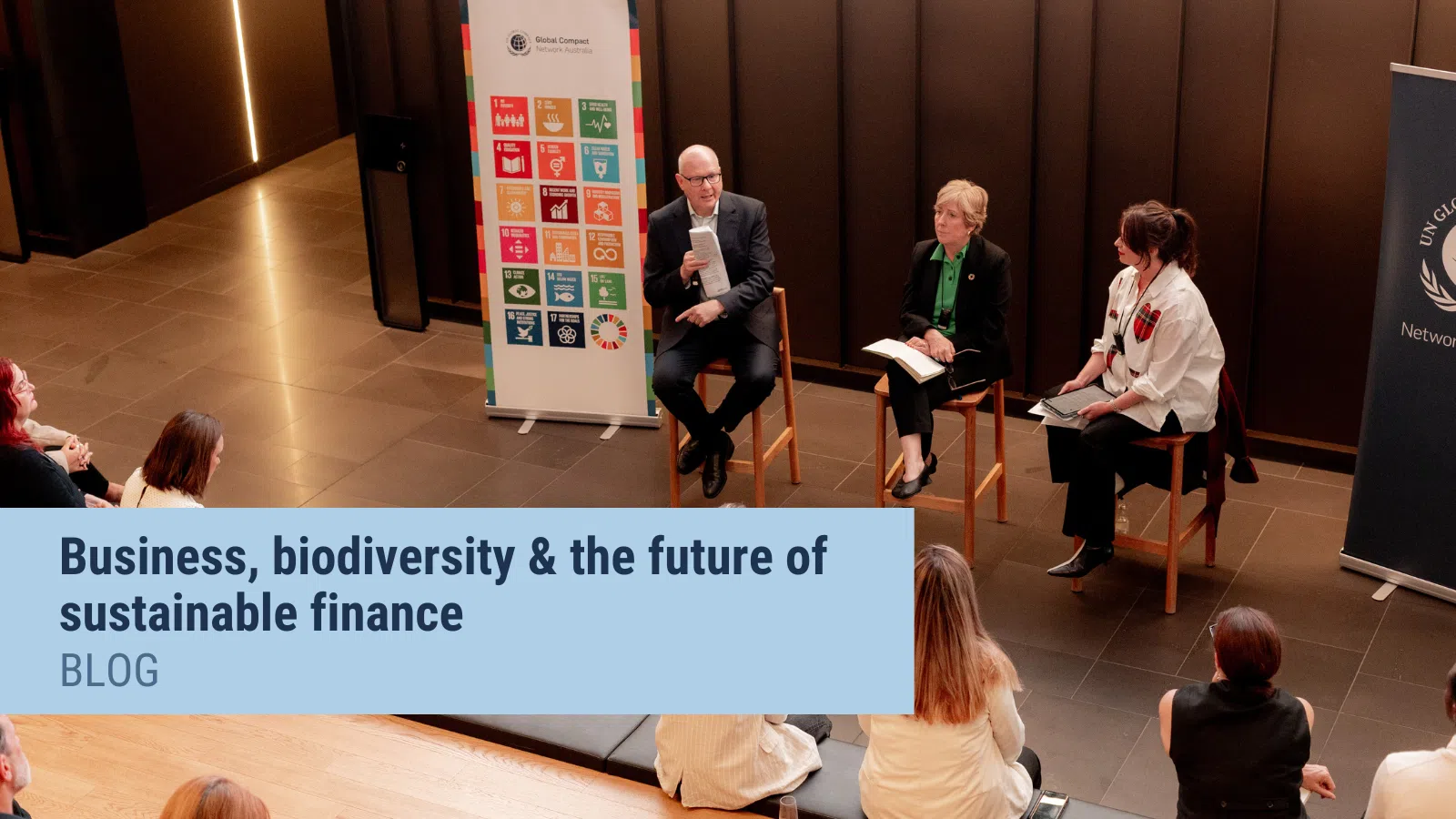
The UN Global Compact Network Australia (UNGCNA) – with support from the PRI and The GPT Group – hosted a discussion on the past, present and future of sustainable finance. The session was opened by The GPT Group’s General Manager, Melbourne Central Tower Tyrone Sheehan and spotlighted international leaders from both the PRI and UNGCNA, with a conversation that specifically explored how Environmental Social and Governance (ESG) mechanisms have evolved from a niche concept to a mainstream investment priority, with trillions of dollars flowing into sustainable solutions such as supply chain decarbonisation, green tech needed for our climate transition, and keys for utilising sustainable finance within sustainable business practice.
Moderated by UNGCNA Executive Director Kate Dundas – the panel featured PRI CEO David Atkin and UNGCNA Board Chair and former PRI CEO, Fiona Reynolds. In it, they called for ESG to move beyond compliance to value creation, with an increased focus on long-term value; effective capital allocation; simpler and less burdensome sustainability frameworks; and redesigning financial systems to capture non-financial risks. Emerging markets were also highlighted as key areas where sustainable investment can deliver both financial and environmental returns.
As businesses and investors fall under increasing pressure to understand their nature and biodiversity risks, the panel stressed the need for collaboration, clear metrics, and shared standards. Frameworks like the Taskforce on Nature-related Financial Disclosures (TNFD) can guide consistent reporting, though measuring ecosystem impacts remains challenging. Greater cooperation between governments, investors, and businesses, especially in emerging markets, is essential to overcome policy and currency barriers and expand nature-positive finance.
Takeaways for business and investors
1. ESG has entered the mainstream
Over the past decade, the PRI has played a pivotal role in embedding ESG into global investment practices. What began as a niche commitment among asset owners has now become a mainstream financial priority, with trillions of dollars flowing into sustainable investments such as supply chain decarbonisation and climate transition solutions. Collaborative initiatives like Climate Action 100+, the UN-convened Net-Zero Asset Owner Alliance, and the Montreal Carbon Pledge have been instrumental in mobilising capital and driving collective corporate accountability.
2. Collaboration and clarity are critical for nature-positive finance
As the discussion on nature and biodiversity gains momentum, both businesses and investors emphasised the need for collaboration, consistent metrics, and shared understanding.
Investors are seeking clearer guidance through frameworks such as the Taskforce on Nature-related Financial Disclosures (TNFD) and want to see companies better articulate the linkages between nature, biodiversity, and climate. Measuring tangible outcomes like carbon reduction is easier than tracking pollution or ecosystem impact, so setting up industry baselines is vital.
Participants also noted that governments and financial institutions must work collaboratively, especially in emerging markets, to unlock capital for nature-positive projects while managing currency and political risks. David Atkin emphasised that “the transition to a nature-positive, net-zero future depends on how effectively we can link biodiversity, climate, and finance and channel capital towards emerging and developing economies.” Workshops, public-private engagement, and transparent communication were identified as key enablers.
3. Long-term value of ESG
Looking ahead, investors and businesses are urged to shift from compliance to value creation. Rather than getting caught up in complex regulations, the focus should move toward long-term value generation through effective capital allocation and innovation.
Simplifying sustainability frameworks, aligning incentives for long-term performance, and addressing short-termism in asset management were seen as essential steps.
As AI, social media, and systemic geopolitical risks reshape markets, David Atkin highlighted that investors must “replumb finance,” redesign systems to assess non-financial risks and reward sustainable performance.
Finally, investing in emerging economies remains a key area, with the right support and engagement, they can deliver both financial returns and environmental protection.
4. Partnerships for the Goals (SDG17)
A unifying message from the panel was that collaboration across investors, businesses, and policymakers will define the next decade of responsible investment.
The sector’s evolution depends on breaking silos, fostering trust, and recognising that profitability and planetary protection can coexist. Panellists highlighted that true challenges and opportunities lie in making capital work for both people and the planet. As explained by Fiona Reynolds, “Once you’ve measured your carbon footprint, you can’t just ignore it. Once you have all of this information, you’ve got to ask: What am I going to do about it?”
Notably, collaborative initiatives like Climate Action 100+, the Net-Zero Asset Owner Alliance, and the Montreal Carbon Pledge continue to drive capital mobilisation and accountability across markets.
Conclusion
The event brought together changemakers, investors, and business leaders to explore the priorities, challenges, and opportunities shaping sustainable finance in the context of the 2030 agenda through candid conversation and shared insight. To ensure the success of future climate initiatives, with the potential of COP31 to be hosted in Adelaide, Australia must demonstrate credible private-sector commitment by mobilising capital, scaling nature and climate solutions, and aligning with global frameworks. As momentum builds globally, nature and biodiversity have moved to the forefront of ESG, shaping both business and investment decisions.
The UN Global Compact Network Australia thanks The GPT Group for their generous support in hosting this event.
Resources
The UN Global Compact Academy offers practical tools for businesses and investors to guide sustainability action. The courses and sessions cover an array of topics, including: Taskforce on Nature-related Financial Disclosures (TNFD); Managing Nature Related Risks and Opportunities with TNFD; and the Nature Deep Dive Series. These help measure ecosystem assets, translate natural capital into financial risk and value, and strengthen nature-positive outcomes.
The PRI continues to lead investor conversations on nature and biodiversity, offering practical frameworks such as the Nature Policy Roadmap and a Natural Capital Depletion tool to help investors assess and manage environmental risks.
Authors: Purvi Rastogi, Environment and Climate Change Intern, UN Global Compact Network Australia; Dr Evan Center, Senior Manager, Environment and Climate Change, UN Global Compact Network Australia.