
News
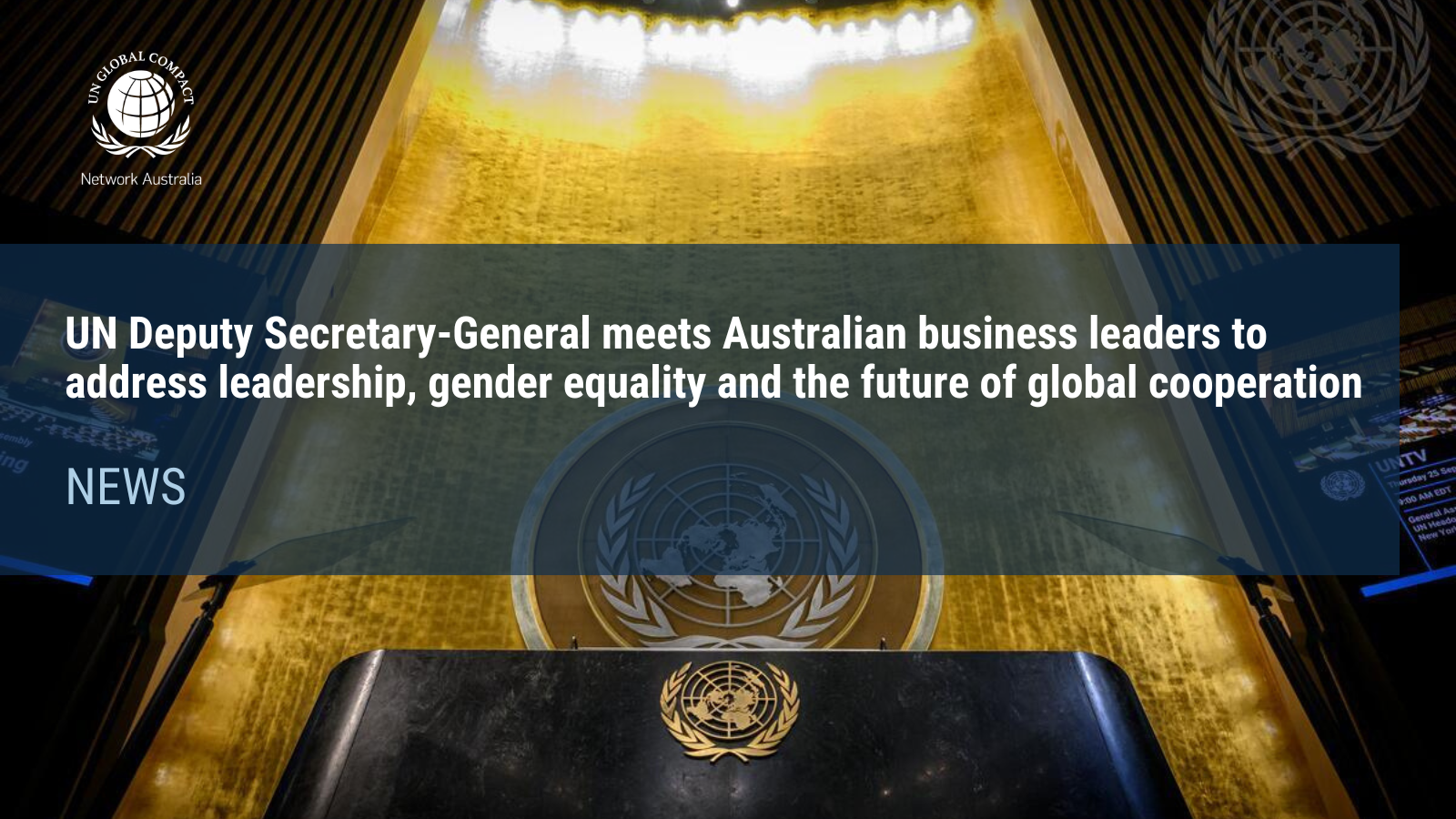
UN Deputy Secretary-General meets Australian business leaders to address leadership, gender equality and the future of global cooperation
Emilia Maubach | April 30, 2026
The UN Global Compact Network Australia (UNGCNA), in partnership with Chief Executive Women (CEW), convened a private leadership roundtable on Monday, 27 April 2026, bringing together the United Nations Deputy Secretary-General, Ms. Amina J. Mohammed, with senior Australian business leaders for a candid exchange on sustainable development, leadership and global cooperation.
Held on the sidelines of the Women Deliver conference, the roundtable provided a forum for frank discussion on the role of the private sector in advancing the UN Sustainable Development Goals (SDGs), strengthening multilateralism and leading through a period of heightened global complexity and fragmentation.
Discussions focused on the importance of multilateralism as essential market infrastructure, and the challenges and opportunities for business leaders to advocate for a rules-based international system that underpins stable trade, climate action and financial markets.
Highlights and key outcomes
- Leadership in a time of global reset
The roundtable acknowledged a moment of profound global transition, with climate change, geopolitical fragmentation, AI and declining trust in institutions reshaping the operating environment for business. Participants emphasised that leadership today requires decisive action with real-world consequences at a planetary scale. - Global cooperation as essential market infrastructure
The discussion underscored that global cooperation underpins economic stability, climate action and, importantly, for business and investors, long-term investment confidence. Business leaders concerned about the risk to global institutions were urged to actively defend and strengthen the rules-based international system at a time when its foundations are being tested. - Gender equality and technology as decisive factors for the next decade
The roundtable highlighted gender equality and inclusive technology—including AI—as critical to sustainable growth. Leaders stressed the urgency of building equality into emerging systems now, warning that waiting until 2030 will be too late. - From commitments to action
Participants called for leaders who can look after the next generation by strengthening governance, including in the areas of gender equality and climate. Strong evidence was noted linking board diversity to better decision-making, investment outcomes and executive leadership pipelines.
H.E. Amina J. Mohammed, Deputy Secretary-General, United Nations, said: “Australia’s business community is demonstrating that responsible leadership and long-term value creation are not in tension — they are the same thing. The UN Global Compact Network Australia is doing vital work in translating global commitments into boardroom action, and conversations like this one remind me why the private sector is indispensable to everything the United Nations is trying to achieve.”
Kate Dundas, Executive Director, UN Global Compact Network Australia, said: “To have the UN Deputy Secretary-General sit with some of Australia’s most influential business leaders for an honest conversation about what responsible leadership actually looks like in practice — that is exactly why this work matters. Australia has a real opportunity to show the world that business can be a force for change, not just a footnote to it. Moments like this one don’t happen by accident. They happen because people are willing to lead.”
The roundtable formed part of UNGCNA’s ongoing engagement with senior business leaders to support alignment between corporate strategy and global sustainability priorities, and to strengthen collaboration between business, government and the United Nations system.
About the UN Global Compact
As a special initiative of the UN Secretary-General, the vision of the UN Global Compact is clear: to mobilise business to transform sustainability ambition into action at the scale the world demands. With more than 25,000 participants and a presence in over 100 countries through 5 Regional Hubs and more than 70 Country Networks and expansion territories, the UN Global Compact is the world’s largest corporate sustainability initiative.
About the UN Global Compact Network Australia
In Australia, UN Global Compact Network Australia (UNGCNA) connects, enables and leads businesses and stakeholders to create a sustainable future by supporting businesses to act responsibly and helping them find opportunities to drive positive business outcomes.


article by
Emilia Maubach
Emilia is a marketing, communications, and events leader with a distinctive combination of legal expertise and a strong focus on sustainability and international relations. Her career spans the legal sector, major global sporting events such as the Australian Open and Wimbledon, and transformative sustainability initiatives, giving her a global outlook and a commitment to integrity, inclusion, and responsible business practices. Emilia holds a Bachelor of Arts in International Relations and Languages, a Master of Laws (admitted to practice), and a Mini MBA in Marketing. Fluent in German and proficient in Spanish, Emilia creates impactful experiences that elevate voices, build connections, and drive meaningful change.